Interactive reference
Send real requests to the k-ID API from the endpoint pages, using your own product's test key.
Every endpoint page under API → Endpoints carries a live request panel. You choose the environment, authenticate, fill in the request, and send it — the call goes from your browser straight to the k-ID API, and the response comes back on the page.
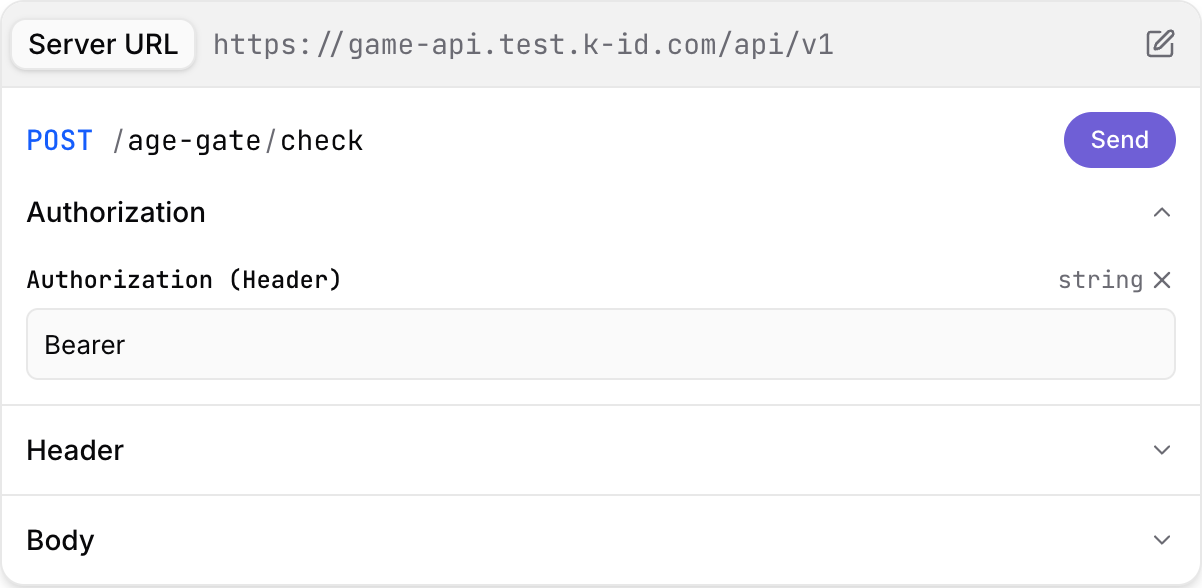
Choose the environment
The Server URL row at the top of the panel shows which environment the request will go to. It starts on test mode:
| Mode | Base URL |
|---|---|
| Test | https://game-api.test.k-id.com/api/v1 |
| Live | https://game-api.k-id.com/api/v1 |
To change it, click the edit icon at the right of the row and pick from the Server URL dialog. Your choice is remembered in the browser and carries to every other endpoint page.
Live mode is real
Requests sent in live mode create real sessions, challenges and verifications against your live product, and emit real webhooks. Use test mode unless you specifically mean to exercise live.
Authenticate
Open the Authorization section. It holds one field, Authorization (Header), prefilled with Bearer — the rest is your product's API key.
Use a key for a product you have access to
Sign in with the Sign in button in the navbar, using the same account you use for Compliance Studio. A Use a product's test key dropdown then appears above the Authorization field, listing the products you can access in your active organization. Pick one and the field is filled in with that product's test-mode key — you never have to copy a key across from Compliance Studio.
A few things follow from how the list is built:
- Test-mode keys only. Live keys are never sent to the docs site. To call live mode, paste a live key in yourself.
- It follows your organization. If you belong to more than one, use the organization switcher in the navbar; the page reloads and the list is rebuilt for the organization you switched to.
- It follows your product access. Members with the Developer role can be scoped to specific products, and the dropdown lists only those. See Product-level access for Developers.
- Products without a test key are left out. If a product has no test-mode key yet, generate one on its Developer Settings page in Compliance Studio. The dropdown does not appear at all when none of your products has one.
Paste a key yourself
You can always type or paste a key into the Authorization field instead — this is the only option when you are signed out, and the one to use for live mode. Get the key from your product's Developer Settings page in Compliance Studio, and make sure it matches the environment selected in the Server URL row: a test key will not authenticate against live mode, or the reverse.
The key stays in your browser
Whichever way it gets there, the value in the Authorization field is kept in your browser's local storage so it carries across endpoint pages. Clear it when you're done on a shared or public machine, and prefer test keys here. See Authentication for how to handle keys in your own code.
Fill in the request
The remaining sections of the panel cover the rest of the request:
- Body on a POST endpoint, Query on a GET one — one input per field, prefilled with an example value. Required fields are marked with a red asterisk, and optional ones carry an
×to unset them. Nested objects expand in place. - Header, on the endpoints that accept optional headers such as
Kid-Target-Product-Id.
For anything easier to type as raw JSON, Open JSON Editor in the Body section swaps the form for a JSON text area and back.
Send it and read the response
Click Send. The result appears at the top of the panel with its status code and body, and Close dismisses it so you can adjust the request and send again.
The field reference below the panel — Authorization, Header Parameters, Body, Response Body — documents every field and every status code the endpoint can return, including the error shapes described in Error handling.
Copy it into your own code
Below the response documentation is a tab strip of code samples — cURL, JavaScript, Go, Python, Java, C# and Rust — generated from whatever is currently in the panel. Fill in the request the way you want it, then copy the sample in your language and it already carries your URL, headers and body.
Want to drive whole flows?
The interactive reference calls one endpoint at a time. To walk an end-to-end flow — age gate, challenge, consent, verification — with the widgets rendered and an event log beside them, use the Dev Explorer, which picks up the same product test keys.